Reader Q&A: What If I Retire and Regret It? (And Other Questions People Don’t Say Out Loud)
Q1) “What if I retire and regret it?”
This is more common than people admit.
Regret usually comes from one of three things:
-
Retiring from something, without a plan for what you’re retiring to
-
Retiring before you feel emotionally ready, even if the money works
-
Retiring without enough flexibility, so you feel trapped by the decision
A helpful way to reduce regret is to make retirement feel like a planned transition, not a cliff edge.
For some people, that means a phased approach, a small ongoing commitment, or simply having a clear structure to the week.
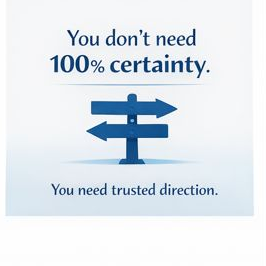
Regret tends to reduce when retirement has direction.
Q2) “I’m financially okay, so why do I still feel uneasy?”
Because retirement isn’t only a financial event. It’s a life change.
Work quietly gives you:
-
routine
-
identity
-
social contact
-
momentum
-
a sense of contribution
When that disappears, it’s normal for your brain to throw up uncertainty—even if you’re “fine on paper”.
The aim isn’t to remove all worry. It’s to replace vague worry with a plan you trust.
Q3) “What if I’m bored?”
Boredom is usually a sign that your retirement plan is missing anchors.
The happiest retirees tend to have 2–3 meaningful anchors in the week, such as:
-
health/fitness routine
-
regular time with family
-
a hobby that has momentum
-
volunteering / contribution
-
a club or social group
You don’t need a packed diary. You need a shape to the week.
Q4) “How do I know if I’m retiring for the right reasons?”
This is a brilliant question.
“Right reasons” usually look like:
-
you’re moving toward something (time, health, freedom, relationships)
-
not just running away from stress or politics
Retiring to escape a bad job can still be valid—
but it’s worth checking whether you’re escaping work itself or just a work situation.
A simple test is:
If you could design work on your terms for 1–2 years (less hours, less pressure), would you still want to stop completely?
Q5) “My partner and I have different ideas of retirement—what do we do?”
This is extremely common.
Retirement can become tense when one person wants:
-
lots of travel and activity
…and the other wants: -
calm, home, routine and simple pleasures
The answer isn’t “agree on everything.”
It’s to agree on:
-
the non-negotiables
-
how much independence you each need
-
how spending decisions will be made
-
what a good week looks like for each of you
The earlier you talk about it, the smoother it tends to be.
Q6) “What if something happens soon after I retire?”
This question often comes from real stories—someone retires, then health changes, or a loved one passes away, and plans get turned upside down.
There’s no perfect protection against life.
But there is a useful takeaway:
If retirement is something you truly want, don’t keep delaying it forever waiting for a “perfect” moment that may never arrive.
At the same time, if you retire earlier, it’s especially important to have:
-
a plan that can adapt
-
sensible buffers
-
and regular reviews to keep things on track
Q7) “Should I retire earlier if I can?”
Sometimes yes. Sometimes no.
The better question is:
If you stop work, will your retirement be meaningful and sustainable—financially and emotionally?
Retiring earlier can be brilliant when:
-
you have flexibility
-
you have a lifestyle plan
-
you have purpose and routine
-
you can handle the uncertainty that comes with a longer retirement
Q8) “What’s the biggest mistake you see people make?”
Retiring with a plan for money… but no plan for life.
It’s surprisingly common.
People spend years preparing financially, then reach retirement and realise they’ve never thought about:
-
how their week will feel
-
what they’ll do with time
-
who they’ll spend it with
-
what they’ll work towards
When lifestyle becomes clear, confidence often follows.
Q9) “How do I stop overthinking this?”
Overthinking is usually a symptom of uncertainty.
The cure isn’t more thinking—it’s more clarity.
Three practical moves:
-
define what retirement looks like for you (a normal week)
-
get clear on the money foundations (spend + income timing + buffer)
-
turn worries into specific “if this happens, we do that” plans
That’s when the decision starts to feel calmer.
Closing thought
As you can see from the questions above, for most people retirement isn’t just a number.
It’s personal.
And it’s rarely one question in isolation. It’s usually the combination—money, emotions and lifestyle all interacting at once.
That’s exactly why I wrote Retirement: It’s Personal—to help people make the decision with clarity and confidence, not guesswork.
Note: This post is general information only and isn’t personal financial advice.
Thank you for subscribing!
Have a great day!